1. Define holonomy:
Holonomous people are reflective, use their strengths for the greater outcome of the group, and learn and grow from within.
2. How does holonomy agree or disagree with what you have learned or what you have done do far in this program?
During my 3 semesters at St. Mary's University, I believe that a lot of my learning has been holonomous. I have done a lot of reflecting, journaling, and researched topics that will make me become a better teacher.
After looking at the sources of holonomy in terms of the five states of mind, I believe that they also relate to what I am doing in the St. Mary's program. Flexibility is one state of mind that I think all teachers need to have. Many things can come up quickly, and teachers need to be able to deviate from their lesson plans with ease if need be. I have worked with teachers who are very stuck in their ways and not flexible. It makes it very hard to collaborate and come up with new teaching strategies when people are resistant to change. Craftmanship is another state of mind that I notice myself and other teachers utilizing. Taking ownership and pride in ones work is something I teach my students. I lead by example and take pride in the lessons or activities that I create for my students. I believe that by being a good role model and showing the students how to take ownership in their work, students will more likely slow down and take pride in their assignments.
3. Are any parts of holonomy more important than others? Why or why not?
After reading the article, I believe that all parts of holonomy need to balanced. Everyone can practice and train to have flexibility, efficacy, consciousness, interdependence, and craftmanship in their profession. Naturally, some things come easier to others and everyone has strengths that they bring to different situations. When working in groups, it is important to acknowledge others strengths and work together in a balanced way. I also believe that if one of these states of mind were missing, or not acknowledged, the dynamics of the group would not be as successful if it were present.
4. Explain each state of mind and how it applies to you as the teacher in your classroom.
Efficacy- Efficacy is using effort to complete tasks.
In my classroom, I make it known that you need to work for what you want. I have a quote hanging in my room that says, " The dictionary is the only place where success comes before work." I refer to this quote often in my room. My students know that everyone has many, many different talents and some things may come easier to others. Everyone is still working, challenging themselves, to becoming smarter and well rounded citizens.
Flexibility- Being able to adapt and look at a situation from another point of view.
This past year, I did a few role playing activities with my students while studying the Civil War. When I first started teaching the Civil War unit, my students automatically assumed that if you lived in the South you had slaves and were a bad person. My students also assumed that everyone in the North did not own slaves and they were all white. I quickly identified this as a misconception I needed to change. I did a little research and found 30+ influential people from the North and South. Each student was given one person and they had to "become" that person. The classmates then interviewed each other and learned about different people who made an impact during the Civil War. After participating in this activity, my students were able to look at BOTH sides of the war and see WHY each side was fighting.
Craftmanship- Improving your performance and taking ownership in your work.
In my classroom, I am very honest with my students. From the very beginning of the year, I tell them that ANYTHING we work on in class could be hung in the hall, displayed in the classroom, or shown to parents at conferences. I tell my class that they should not be embarrassed with their work being displayed if they take their time and are proud of their work. At the beginning of the year, a lot of my boys just wanted to be the first ones done with all of their work. They had to learn the hard way after I hung up some of their poems in the classroom. After they read other classmates poems and saw how much work other students put into the assignment, they immediately felt guilty. A few of the students even asked if they could re-do their assignment and hang it on the wall. This was a life lesson that they learned the hard way. I am hoping they continue to take pride in their work for many years to come.
Consciousness-A conscientious person is aware of their values, behaviors, and their goals. Because they are aware of these things, there is little time wasted and more time achieving their goals.
As a teacher, I need to be very conscientious in my classroom. I want all of my students to be successful in their studies. All students have different needs. I do a lot of group work and stations for my students needs to be met. Since there are many things going on at once in my room, I need to be aware and "train" my students for different situations. These adjustments and sills take some time to develop. After a few weeks of practice, students are in a routine and able to self monitor their behavior and learning.
Interdependence- Working toward a common goal with a group.
As I stated above, my students do a lot of work in groups. I state the learning objectives before each lesson. My students know what they need to have accomplished and learned by the time they are done with that group work activity.
Monday, June 24, 2013

Saturday, May 4, 2013
Abstract-Interactive Math Notebooks
Does the amount of effort put into an Interactive Math Journal correlate with test scores?
Heather Smith
Otsego Elementary School, Otsego, MN
As a fifth grade teacher, I was curious how the use of interactive math journals would effect my students test scores. The goal is to show that by having my students complete various hands on activities, take guided notes, and reflect upon their learning, their test scores would increase. I looked at chapter math tests and also the final MCA test results.
At the beginning of the year, I gave each of my students a composition notebook and explained that these were their math journals. Throughout the year, when I would teach a new skill or strategy, the students would take guided notes, or copy my procedure into their notebooks and reflect on their learning after the lesson. These lessons usually included some type of hands on manipulative they had to glue into their notebook. Students were encouraged to take their math journal home to help with homework.
After participating in interactive math journal activities for 6 months, I noticed my students referencing their journals when they were stuck on a complicated problem. I also noticed an increase in the class average on each test that was taken.
I collected ten students interactive math journals and I have graded their entries on an effort rubric. I then looked at these ten students, who were selected randomly, and looked at their test scores to see if the amount of effort put into the reflection correlated with their test score. ***I am still collecting data to report results on. ***
Heather Smith
Otsego Elementary School, Otsego, MN
As a fifth grade teacher, I was curious how the use of interactive math journals would effect my students test scores. The goal is to show that by having my students complete various hands on activities, take guided notes, and reflect upon their learning, their test scores would increase. I looked at chapter math tests and also the final MCA test results.
At the beginning of the year, I gave each of my students a composition notebook and explained that these were their math journals. Throughout the year, when I would teach a new skill or strategy, the students would take guided notes, or copy my procedure into their notebooks and reflect on their learning after the lesson. These lessons usually included some type of hands on manipulative they had to glue into their notebook. Students were encouraged to take their math journal home to help with homework.
After participating in interactive math journal activities for 6 months, I noticed my students referencing their journals when they were stuck on a complicated problem. I also noticed an increase in the class average on each test that was taken.
I collected ten students interactive math journals and I have graded their entries on an effort rubric. I then looked at these ten students, who were selected randomly, and looked at their test scores to see if the amount of effort put into the reflection correlated with their test score. ***I am still collecting data to report results on. ***
Sunday, April 28, 2013
Teaching the Civil War: Using Literature to Support Student Learning
One of my favorite Social Studies unit to teach is the Civil War. The past two years I have been using literature to give some depth to my lessons.
 This is a wonderful book to read when talking about the Underground Railroad. Clara is a slave and makes a quilt that is really a map that will lead slaves to freedom.
After I read the book, I had my students make a classroom "freedom quilt." The students used geometric shapes and color to symbolize different things in nature. The students then had to write a paragraph explaining what their quilt square resembled.


The Underground Railroad: Henry's Freedom Box
Henry's Freedom Box is another great story that shows students the lengths slaves went through to get to freedom. This is a true story about how Henry Brown mailed himself to the North so he would be considered free.


The Civil War
This is a choose your own adventure book that is ALWAYS flying off my shelf! There is a different story every time you read it!
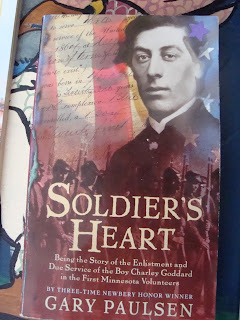
 Soldier's Heart by Gary Paulsen
This book is about a 15 year old Minnesota boy that lies about his age to join the Army. This is a historical fiction book that describes Charley's time spent in the Army during the Civil War.
 The Mostly True Adventures of Homer P. Figg by Rodman Philbrick
Twelve-year-old orphan Homer runs away from Pine Swamp, Maine, to find his older brother, Harold, who has been sold into the Union Army. Homer outwits and outruns Civil War-era thieves, scallywags, and spies as he makes his way south, following clues that finally lead him to Gettysburg.
 I have also brought in from the Wright County Historical Society a trunk filled with Civil War artifacts. The students really LOVE looking at all of the belongings from the Civil War.


~Heather
The Underground Railroad: Sweet Clara and the Freedom Quilt

After I read the book, I had my students make a classroom "freedom quilt." The students used geometric shapes and color to symbolize different things in nature. The students then had to write a paragraph explaining what their quilt square resembled.


The Underground Railroad: Henry's Freedom Box
Henry's Freedom Box is another great story that shows students the lengths slaves went through to get to freedom. This is a true story about how Henry Brown mailed himself to the North so he would be considered free.

Chapter Books
Whenever I start a new unit in Social Studies, I always display chapter books for the students to read during Read to Self time.
Bull Run by Paul Fleischman
This book is told from the perspective of 16 different people who were alive during the Civil War. There are characters from the North and the South. Even the most reluctant reader will enjoy this book.

This is a choose your own adventure book that is ALWAYS flying off my shelf! There is a different story every time you read it!

This book is about a 15 year old Minnesota boy that lies about his age to join the Army. This is a historical fiction book that describes Charley's time spent in the Army during the Civil War.

Twelve-year-old orphan Homer runs away from Pine Swamp, Maine, to find his older brother, Harold, who has been sold into the Union Army. Homer outwits and outruns Civil War-era thieves, scallywags, and spies as he makes his way south, following clues that finally lead him to Gettysburg.


I hope this inspires you to add a few new things to your Civil War curriculum.
~Heather
Saturday, April 13, 2013
My Life as a Reading Teacher
I encourage my students to read 20 minutes each night. In the past, I have had students fill out a reading calendar. Yes, it was easy for me to see if the students had been reading or not, but it did not give me a chance to hold my students accountable for their reading. At the end of last year, I felt that a lot of my students were being dishonest about the amount of reading they had been doing at home.
This year I implemented at home reading notebooks. Each week, my students are responsible for writing me a letter about what they have been reading on their own time. This is one way for me to see WHAT the students are reading and IF they are comprehending it. I really enjoy reading and responding to my students journals. Yes, it is a lot to manage and a lot of writing, but I feel like it is worth it. This is also a place for me to suggest new books for students to read and a place for students to work on their writing.
I stapled a list of writing topics on the top of the page that students could write about. Here are the forms that my students have in their journals. My students liked the choice of what they could write about. It was nice to have my students branch out and try new things instead of ALWAYS writing a summary of what they read.
I am planning on creating a rubric to grade my students on for next year. I am hoping to continue to add and improve upon these reading notebooks.
Hopefully this post inspires you to try this in your classroom!
~Heather
This year I implemented at home reading notebooks. Each week, my students are responsible for writing me a letter about what they have been reading on their own time. This is one way for me to see WHAT the students are reading and IF they are comprehending it. I really enjoy reading and responding to my students journals. Yes, it is a lot to manage and a lot of writing, but I feel like it is worth it. This is also a place for me to suggest new books for students to read and a place for students to work on their writing.
I stapled a list of writing topics on the top of the page that students could write about. Here are the forms that my students have in their journals. My students liked the choice of what they could write about. It was nice to have my students branch out and try new things instead of ALWAYS writing a summary of what they read.
I am planning on creating a rubric to grade my students on for next year. I am hoping to continue to add and improve upon these reading notebooks.
Hopefully this post inspires you to try this in your classroom!
~Heather
Saturday, April 6, 2013
Interactive Math Journals (Action Research)
I have been implementing interactive math journals in my class this year. I use these journals as a place for my students to take guided notes, participate in in-class activities, and have concrete examples of formulas or processes to math equations. I started journaling with my class in October and I have noticed a lot of student successes this year.
On the last two tests, ALL of my students have scored 80% or higher!!! I hope their high scores are from deeper understanding of the concepts by using the interactive math notebooks.
Things that I would do differently for the future are:
- Students using their journals to help with homework before asking a teacher for help!
- Students taking guided notes to increase understanding
- Students synthesizing what they learned
On the last two tests, ALL of my students have scored 80% or higher!!! I hope their high scores are from deeper understanding of the concepts by using the interactive math notebooks.
Things that I would do differently for the future are:
- make students write in pen. The pencil has been smearing on some of my students notebooks. I am hoping for next year to use different colored pens instead of markers too. (I found some GREAT ones at Wal-Mart. a 10 pack of every color under the rainbow for $1.98)
- Use spiral 3-5 subject notebooks. The composition notebooks work okay, but after gluing a lot of extra materials in, the notebooks no longer close.
- Have my students ALWAYS use the same page number as my example. Some of the kiddos have a hard time following directions... well their notebooks are a MESS!
Saturday, March 2, 2013
Spring Conference-Phase 2
Well I registered for my last 3 sessions for the St. Mary's spring conference in April.
One of the sessions is about the implementation of the growth mindset in Writer's Workshop and how it motivates students to gain leadership skills in writing. My goal for the 2012-2013 school year was to improve my students writing skills by incorporating MORE writing activities in my everyday lessons. I feel this has been successful. I am interested to see what this presenter has to add about writer's workshop. There are always new things to learn and implement in a classroom. I know I have been focusing a lot on math for my action research projects, so attending this writing seminar will be a breath of fresh air.
A second session I am attending is about improving comprehension skills by using verbal, written and visual activities. Comprehension is always an area that students can work to improve. I feel like this session will give me a lot of new intervention and extension activities that I can include in my classroom. I am always looking for new ways to improve my students comprehension.
The third session I registered for in phase 2 is about differentiation in a middle school math class. I feel like fifth graders are in a transition to middle school. Attending this session will give me many new ways to support my struggling students as well as students who need extension activities. All of my action research projects so far have been about math and I feel like this session will help support me with further research. I have always been told that your students will raise up to the challenge if you teach them like they are one grade level ahead. Attending a middle school seminar will be helpful for me to challenge all of my students.
One of the sessions is about the implementation of the growth mindset in Writer's Workshop and how it motivates students to gain leadership skills in writing. My goal for the 2012-2013 school year was to improve my students writing skills by incorporating MORE writing activities in my everyday lessons. I feel this has been successful. I am interested to see what this presenter has to add about writer's workshop. There are always new things to learn and implement in a classroom. I know I have been focusing a lot on math for my action research projects, so attending this writing seminar will be a breath of fresh air.
A second session I am attending is about improving comprehension skills by using verbal, written and visual activities. Comprehension is always an area that students can work to improve. I feel like this session will give me a lot of new intervention and extension activities that I can include in my classroom. I am always looking for new ways to improve my students comprehension.
The third session I registered for in phase 2 is about differentiation in a middle school math class. I feel like fifth graders are in a transition to middle school. Attending this session will give me many new ways to support my struggling students as well as students who need extension activities. All of my action research projects so far have been about math and I feel like this session will help support me with further research. I have always been told that your students will raise up to the challenge if you teach them like they are one grade level ahead. Attending a middle school seminar will be helpful for me to challenge all of my students.
Saturday, February 23, 2013
St. Mary's University-Spring Conference
This morning I registered for two of my five sessions to attend at the spring conference. Looking at the course catalog was very overwhelming. I chose two sessions that relate to fifth grade.
The first sessions I signed up for is about 4th grade students mastering their multiplication facts. I chose this session because I always hope my students come to 5th grade with these facts mastered, but there is always a handful of students who do not have multiplication fact fluency. I am hoping to get a lot of new ideas to use as interventions with my students.
The second session I registered for is about incorporating movement into the classroom. The presenter has researched different activities and is incorporating brain based movements. I have started using Whole Brain Teaching strategies in my classroom and I think this session will help me improve my WBT in my classroom.
I get to register on Wednesday for the next three sessions. I am hoping to choose three more sessions to improve my teaching and inspire me to try something new in my classroom.
The first sessions I signed up for is about 4th grade students mastering their multiplication facts. I chose this session because I always hope my students come to 5th grade with these facts mastered, but there is always a handful of students who do not have multiplication fact fluency. I am hoping to get a lot of new ideas to use as interventions with my students.
The second session I registered for is about incorporating movement into the classroom. The presenter has researched different activities and is incorporating brain based movements. I have started using Whole Brain Teaching strategies in my classroom and I think this session will help me improve my WBT in my classroom.
I get to register on Wednesday for the next three sessions. I am hoping to choose three more sessions to improve my teaching and inspire me to try something new in my classroom.
Subscribe to:
Posts (Atom)